
Home · Summer School
The Summer School
The Central Asian Summer School gives future Jessup competitors a shared foundation before the competition season begins. Held in early August, before the new Jessup Problem is released, it brings together students for five or six days of intensive learning in public international law, legal research and writing, and oral advocacy.
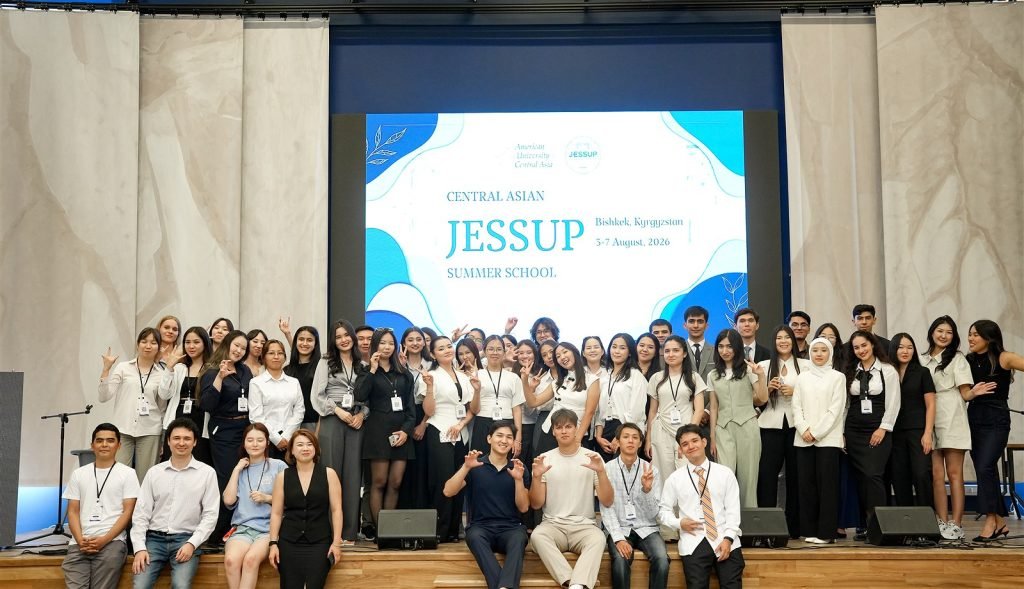
Central Asian Summer School, Bishkek, August 2026.
For universities in the region
Host a Future Summer School
Hosting rotates between Kazakhstan, Kyrgyzstan and Uzbekistan. The Administration prepares the academic programme and coordination; the host university supports the local delivery of the week.
How the Summer School works
The first Central Asian Summer School was held in Astana in 2022, building on Jessup training initiatives that began in 2017. It was created in response to a practical challenge: students come to the Jessup with different opportunities to study international law and develop mooting skills. The Summer School gives them access to the same core instruction, improves the quality of team preparation and helps universities establish a lasting tradition of participation.
The programme is deliberately non-competitive. Students meet one another first as classmates rather than opponents, giving them space to exchange ideas, form friendships and become part of a regional community before the season begins. The Summer School is in English.
Who Can Attend
The Summer School is intended for students who may participate in the Jessup for the first time. Students who have already competed are not eligible to attend as participants, and each student may attend the Summer School only once.
Universities therefore nominate a new group each year, allowing more students to receive Jessup training and gradually building a wider base of experience within their law faculties. Some participants join their university’s team that season; others use what they have learned to prepare for team selection in a later year.
The programme is primarily for students from Kazakhstan, Kyrgyzstan and Uzbekistan. Where places permit, students from other countries may also be invited to attend.
We are also aiming to expand the Summer School to Tajikistan and Turkmenistan. If your university is based in one of these countries and would like to join, let us know.
Because all teaching and practical exercises are conducted in English, participants should have sufficient English proficiency to follow classes, prepare arguments and present oral submissions.
Coaches and faculty members are welcome to observe the programme and do not need to register as participants. They should arrange and cover their own travel, accommodation and meals.
Former competitors cannot return as students, but they are encouraged to contribute as instructors and volunteers.
Registration
Students do not apply individually. Each university registers up to four students through its profile in the Jessup Central Asia System.
If you would like to attend, speak to your law faculty about the university’s participation. If your university is new to the Jessup or needs assistance with registration, contact us at admin@jessupcentralasia.com.
What the Week Covers
The backbone is fixed every year: sources and subjects of international law, the law of treaties, and a three-part sequence on state responsibility — the ground a Jessup problem is most likely to stand on. Each session is led by a practitioner or academic from the region or abroad. Layered on top, visiting specialists bring a rotating slate of subjects — immunities, the law of the sea, international criminal law, among others — that changes from one year to the next.
Skills run in parallel: research, then writing, then oral advocacy and direct coaching on dealing with judges. Participants work the mini-moot problem in groups across the week, then argue it in front of a judging panel of practitioners and academics — for most, the first time they argue in front of a panel.
Core curriculum
Every year
▶ Sources & subjects of international law
▶ Law of treaties
▶ State responsibility (three-part sequence)
▶ International Court of Justice
▶ Legal research & legal writing
▶ Oral advocacy & dealing with judges
Specialist sessions
Varies by year
▶ Immunities
▶ Law of the sea
▶ International criminal law
▶ International humanitarian law
▶ International human rights law
▶ International commercial arbitration
The Mini-Moot
Participants receive a mini-moot problem on the first day of the Summer School. Over the course of the week, they learn how to analyse the issues, develop legal arguments and prepare their oral submissions.
On the final day, each participant pleads before a panel of two judges and receives oral feedback. The exercise gives students their first experience of answering questions from a bench in a supportive setting, without rankings, awards or competitive results.
Participants who complete the programme receive a certificate.
Building Experience Within Universities
The Summer School is designed to benefit more than the students attending in a particular year. Because universities nominate new participants for every edition, Jessup knowledge gradually spreads beyond a single team.
Former participants return to their faculties with a clearer understanding of the competition and a stronger basis for future preparation. Over time, they may become competitors, coaches, judges, mentors or volunteers. Their experience helps universities preserve knowledge between seasons and develop a lasting Jessup tradition.
This cycle also strengthens the regional community. Each new group learns from those who came before it and, in time, contributes to the preparation of those who follow.
Participation Arrangements
There is no participation fee, but students or their universities are responsible for arranging and covering travel to and from the host city.
We work with the host university to make attendance as accessible as possible. Where its resources allow, visiting students may be offered accommodation and meals, generally to student participants only — coaches and faculty members should make their own arrangements. The support available varies from year to year and is confirmed before each Summer School.
We can also provide invitation letters to participants who require them for travel or visa purposes.
Teach at the Summer School
The Summer School is taught by academics, practitioners and former Jessup competitors from Central Asia, with international instructors joining in some years. They lead sessions, mentor participants and judge the final mini-moot. Some also return to judge the Central Asian Rounds.
Interested in teaching or mentoring at a future Summer School? Tell us about the subject topic you would like to cover.
Support the Summer School
Support from law firms and partner organisations helps us provide teaching materials, accommodation and meals, making it possible for students to attend the Summer School free of charge.
If your organisation would like to help, we would be delighted to hear from you.
Interested in teaching, mentoring or supporting a future Summer School? admin@jessupcentralasia.com →
Past seasons
| Year | City | Host university | |
|---|---|---|---|
| 2026 | Bishkek | American University of Central Asia | Photographs on Flickr → |
| 2025 | Almaty | Narxoz University | Photographs on Flickr → |
| 2024 | Tashkent | Tashkent State University of Law | Photographs on Flickr → |
First time entering
I’m New
Eligibility, team size, finding a coach, registration and fees.
This season
Central Asian Rounds
Dates, host and everything you need to know for the current season.